
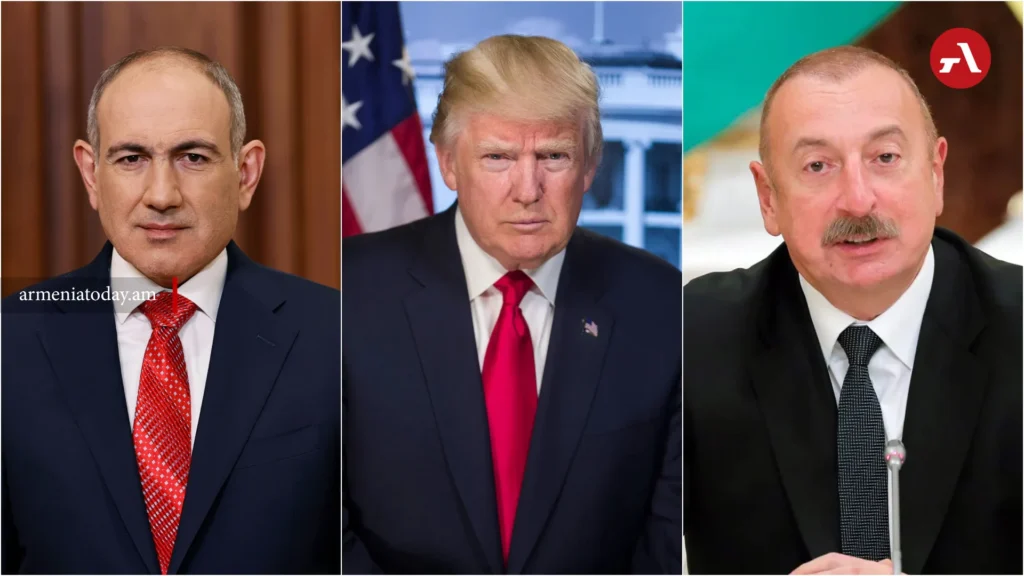
Official Yerevan has confirmed the meeting between Armenian Prime Minister Nikol Pashinyan and Azerbaijani President Ilham Aliyev in Washington, mediated by U.S. President Donald Trump.
On August 6, the Armenian government announced that “on August 7–8, Prime Minister of the Republic of Armenia Nikol Pashinyan will visit the United States, where he will hold a bilateral meeting with U.S. President Donald J. Trump to deepen the strategic partnership between Armenia and the United States, and participate in a trilateral meeting with the U.S. President and the President of Azerbaijan aimed at promoting peace, prosperity, and economic cooperation in the region.”
“A document of intent to continue the peace process is a step toward ending hostilities between Armenia and Azerbaijan…”
Analysts suggest that a document may be signed during the trilateral meeting, though it is unlikely to be a definitive “peace agreement.”
In an interview with VECTORS.am, American historian and political scientist John Stanley Micgel, a professor at the Center for East European Studies at the University of Warsaw, explained that if a document of intent to continue the peace process is signed at the Pashinyan-Aliyev meeting in Washington, it should be viewed as a step toward ending hostilities between Armenia and Azerbaijan.
“From what is known, a framework document has already been agreed upon; all that’s needed is the political will of both countries and a little U.S. support to push the ball into the goal. Naturally, each such step moves these countries further from Russia’s orbit, reduces Iran’s influence, and integrates them into the regional transport system, strengthening their economies,” he said.
“For the U.S., this is an easy way to enter the region…”
The professor believes this will be an easy way for the U.S. to gain a foothold in a region that has long played a minor role in U.S. geostrategy.
“For President Trump, facilitating reconciliation between two rivals would be a success in itself, potentially creating not only a gateway between Iran and Russia but also a springboard for American business,” Micgel said. He added that “for President Trump, any outcome of the Pashinyan-Aliyev meeting is already a win, and if Messrs. Pashinyan and Aliyev can act soberly, their countries will benefit as well. Additionally, the Tehran-Moscow axis will suffer, which will also benefit Ukraine.”
“We are dealing with a state apparatus whose key decisions are not made in Yerevan…”
According to international relations expert Armen Manvelyan, the fact that Armenia did not officially confirm the Washington meeting until the last moment speaks volumes about the country’s level of sovereignty.
“No state institution confirmed the upcoming meeting until the very last moment. This is an extremely alarming signal, indicating that we are dealing with a state apparatus whose key decisions are not made in Yerevan. It is a measure of our sovereignty and Armenia’s international authority—or rather, its absence,” the expert noted.
“A full-fledged peace treaty will not be signed in Washington…”
Manvelyan predicts that a comprehensive peace treaty will not be signed in Washington.
“At most, we can expect the signing of some document of intent, expressing desires or perhaps outlining future initiatives. This step will undoubtedly boost Donald Trump’s ratings, and possibly Ilham Aliyev’s as well. But it will definitely not benefit Armenia,” he emphasized.
He also expressed confidence that, regardless of the document’s content, Armenia’s current prime minister will present it as a significant diplomatic victory.
It should be noted that the Pashinyan-Aliyev meeting in Washington is taking place amid significant geopolitical turbulence: the U.S. has intensified its efforts in the South Caucasus while Russia seeks to maintain its positions. In this context, Armenia increasingly finds itself not as a participant but as an object of international processes. The lack of transparency in decision-making and the weak involvement of civil society and the opposition in discussions of peace initiatives only heighten domestic tensions.
The material was prepared by Marina Brutyan