
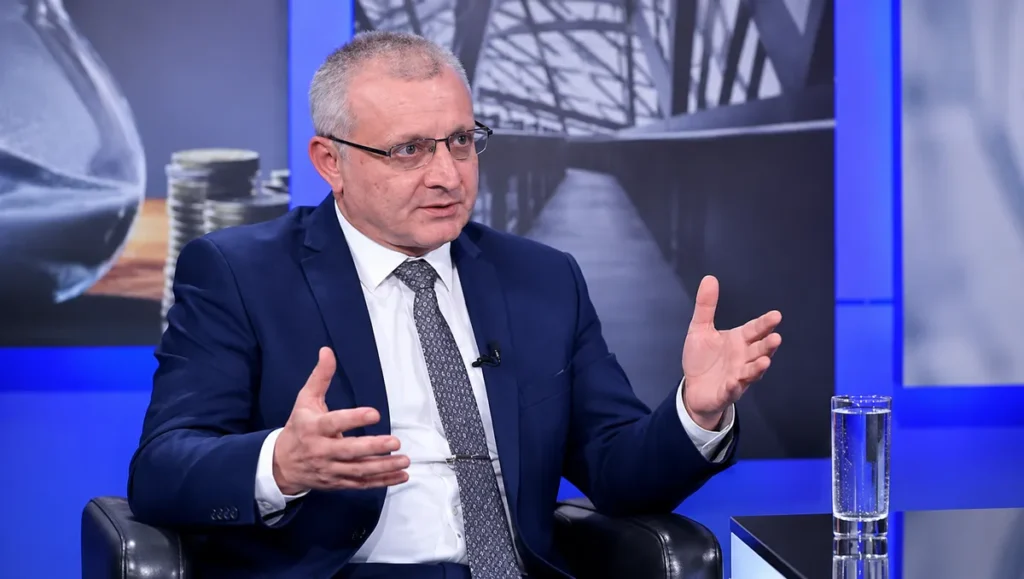
Armenian Prime Minister Nikol Pashinyan is now openly acknowledging that changing Armenia’s Constitution is a demand made by Azerbaijani President Ilham Aliyev and is trying to turn the issue into a tool of domestic political pressure, political analyst Suren Surenyants says. In his view, the prime minister’s chosen path will deepen repression and lead to civil clashes rather than political solutions.
The analyst notes that Pashinyan has repeatedly discussed the need to change the Constitution in recent days, linking it to the Armenian-Azerbaijani peace process. While that link was presented indirectly before the parliamentary elections, the prime minister now openly acknowledges, in Surenyants’s assessment, that the issue of constitutional change stems from Azerbaijan’s demands.
According to Surenyants, Pashinyan is ignoring an important political reality: the parliamentary elections have only just ended. Their results gave him the right to form a government, but they did not give the Civil Contract party a mandate to change the Constitution on its own.
The analyst recalls that during the election campaign, Pashinyan presented the two-thirds support needed for constitutional changes as a vital condition, even warning that otherwise there would be war in September. Nevertheless, regardless of allegations of election fraud, the official results did not give Pashinyan the authority to carry out constitutional changes single-handedly.
Surenyants argues that under these circumstances, Pashinyan could have turned the election results into diplomatic capital and negotiated with Azerbaijan to remove the constitutional issue from the Armenian-Azerbaijani peace agenda. The analyst believes there were other ways to address Azerbaijan’s concerns. Instead, he says, the prime minister went in the opposite direction, turning external pressure into domestic blackmail.
According to Surenyants, Pashinyan will now try to obtain a certain solution from Aliyev and then use it to pressure the opposition. The prime minister’s calculation, the analyst says, is to generate public pressure on the opposition to secure the six or seven additional votes needed for constitutional changes. However, the two opposition factions have already said they will not yield to that blackmail or vote for constitutional changes demanded by Aliyev.
Surenyants believes Pashinyan will attempt to repeat the scenario of October 2, 2018, when the prime minister drew on strong public support to bring people to the grounds of the National Assembly and compel parliament to call snap elections. In the analyst’s view, however, the situation has changed substantially six years later, and the conditions needed to repeat that precedent no longer exist.
He points to three factors.
First, Pashinyan no longer has the level of public support he enjoyed in 2018. According to Surenyants, the prime minister’s high approval rating at the time made it possible even to legitimize political blackmail or offset it through public support. That resource is now gone. The analyst says that even if the official parliamentary election results are accepted, Pashinyan does not have the support of 50 percent of the public.
Second, Surenyants believes that a society with its own state cannot unite around the agenda of a hostile state. He emphasizes that Armenia has no intention of giving up its statehood and that the parliamentary election results showed a willingness within society to resist external pressure. For that reason, he says, it is impossible to expect the public to rally around Azerbaijan’s demands.
Third, the analyst points to deep social polarization. He says Pashinyan relies on a certain segment of supporters in Armenia, while there is also a fairly motivated opposition segment. Surenyants notes that the reasons for supporting the prime minister may vary, from pressure and fear of losing a position to an interest in preserving income. None of that, he says, changes the fact that society is polarized.
“Polarized societies do not consolidate,” the analyst stresses. In Surenyants’s assessment, if Pashinyan tries to carry out his stated policy of pressuring the opposition, it will not produce a political resolution. On the contrary, in a polarized society, those steps could develop into civil clashes, even civil war. The analyst believes the prime minister’s chosen course will deepen repression, while resistance to it could put the country at risk of internal conflict.
👉 Politics