
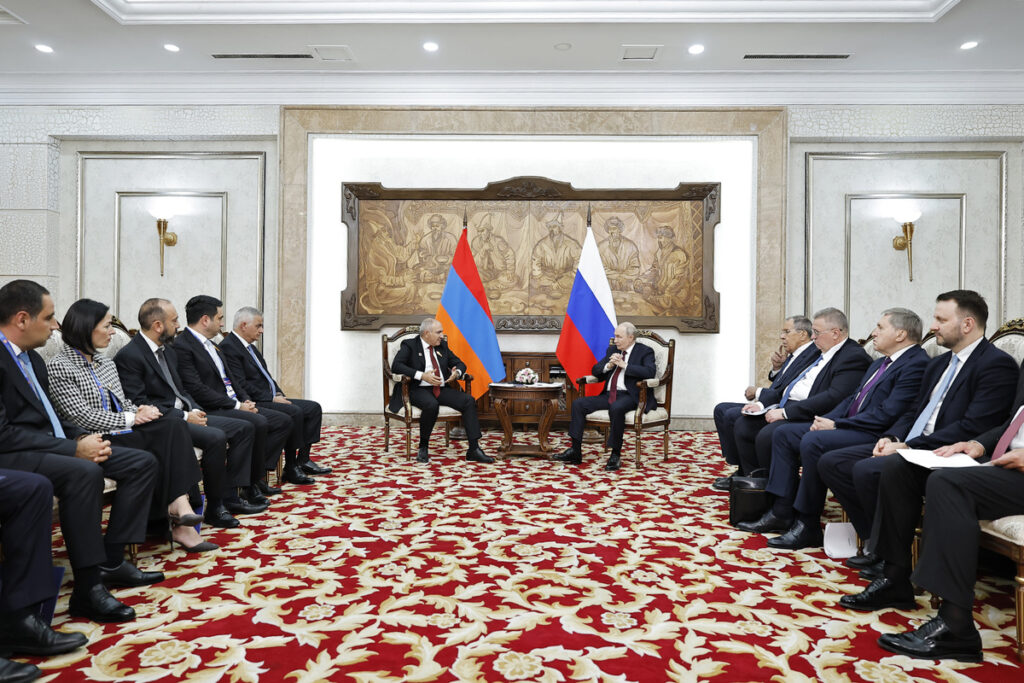
The main outcome of the September 1 meeting between the leaders of Armenia and Russia can be considered the two sides’ agreement to reconsider the current model of bilateral relations, political scientist Sergey Melkonyan said.
According to him, no specific agreements were announced during the public part of the meeting. However, the statements made suggest that Yerevan and Moscow understand that the previous format of relations no longer exists, while a new one has yet to take shape.
“The old modality of relations no longer exists, while the new one has not yet been formed. As I understand it, this was essentially the agreement — to reconsider various forms of cooperation in strategic areas,” Melkonyan said.
According to Melkonyan, the main question now is what form this reconsideration of relations will take — constructive or destructive.
Moscow’s Two Possible Approaches
The political scientist identifies two possible scenarios for Russia’s future policy.
Under the first scenario, Russia could accept the change in its position in the region, given that Ukraine remains its long-term priority. In this case, Moscow could gradually withdraw from the region while retaining some of its existing assets in its relations with Armenia.
The second scenario is resistance. In this case, Russia would seek to preserve its long-term strategic interests and presence in the region.
According to Melkonyan, Moscow is not currently prepared to make unilateral concessions, particularly on the railway issue.
At the same time, there is a contradiction in Russia’s approach to the military base and the railway.
While Moscow is seeking to maintain its presence in the railway sector, Russian rhetoric regarding the military base has become softer.
Melkonyan explains this through several factors.
First, Russia may still not consider the Armenian-Azerbaijani peace process to be firmly established. There is still no peace treaty, several issues remain unresolved, and Moscow may continue to assess the likelihood of threats to Armenia’s security as high.
Under this logic, Russia assumes that Armenia may once again turn to Moscow for security assistance in the future.
On the other hand, the strategic value of Russian military bases itself has changed.
According to Melkonyan, amid changes in the regional geopolitical configuration, the importance of the Russian military base in Armenia to Russia may have declined.
Whereas Armenia previously effectively represented a zone of direct contact between Russia and NATO, the situation is different today.
The Armenian-Turkish border is also an important element of relations between Russia and Turkey, which themselves include both cooperation and elements of confrontation.
Under these circumstances, Russia may calculate that the political cost of maintaining the military base is too high.
Distrust Between Armenia and Russia Continues to Deepen
According to Melkonyan, there is currently a serious deficit of trust in relations between Armenia and Russia.
Even if Armenia declares that the railway will remain entirely under Armenian control and will not be transferred to another country, Moscow may not believe it.
According to him, Russia may perceive Armenia’s policy not as diversification but as a shift toward the “hostile West.”
“If the issue of trust is not resolved, every step, even a constructive one, may be perceived as hostile,” he said.
Melkonyan views the absence of Russia as a priority direction in the Armenian government’s program as an important political signal.
In his opinion, this may indicate that Yerevan has already decided to pursue foreign policy diversification and deepen relations with the West.
At the same time, the political scientist does not rule out the possibility that Armenia has received certain promises from Western partners regarding economic and financial support.
However, he stresses that under the changing world order, no country can provide Armenia with 100% security guarantees.
Could Russia Exert Military Pressure on Armenia?
Addressing concerns that Moscow could resort to military pressure amid worsening relations between Russia and Armenia, Melkonyan said that Russia certainly has such capabilities.
However, the main issue is not military capability but the political expediency of using it.
At the same time, he warned that threats to Armenia’s security should not be viewed solely from the perspective of Russia.
“We have two neighbors that are de facto and de jure waging war against us,” he said, referring to the blockade policy pursued by Azerbaijan and Turkey toward Armenia.
In his view, Russia may calculate that even if Moscow completely withdraws from Armenia, pressure on Armenia will continue as long as there is no peace treaty and Azerbaijan’s demands remain unrestricted.
However, according to the political scientist, there is a contradiction here: Russia’s presence in the past also failed to prevent pressure on Armenia from escalating into military action.
The Problem with Previous Security Guarantees
Melkonyan stresses that representatives of Armenia and Russia, in his view, understand well that Russian security guarantees did not work in the past as expected.
He singled out the military hostilities of September 2022, noting that those events represented a red line for Armenia.
At the same time, the political scientist draws attention to Russia’s repeated assertion that the Nagorno-Karabakh issue did not fall within the CSTO’s area of responsibility.
According to Melkonyan, if the Russian leadership consistently maintains that the events in Karabakh were unrelated to the territory of the Republic of Armenia and to CSTO obligations, this means that Moscow does not regard the September events as actions directed against the Republic of Armenia itself.
In his assessment, this is no longer merely a political issue but also a serious communication problem between Yerevan and Moscow.